
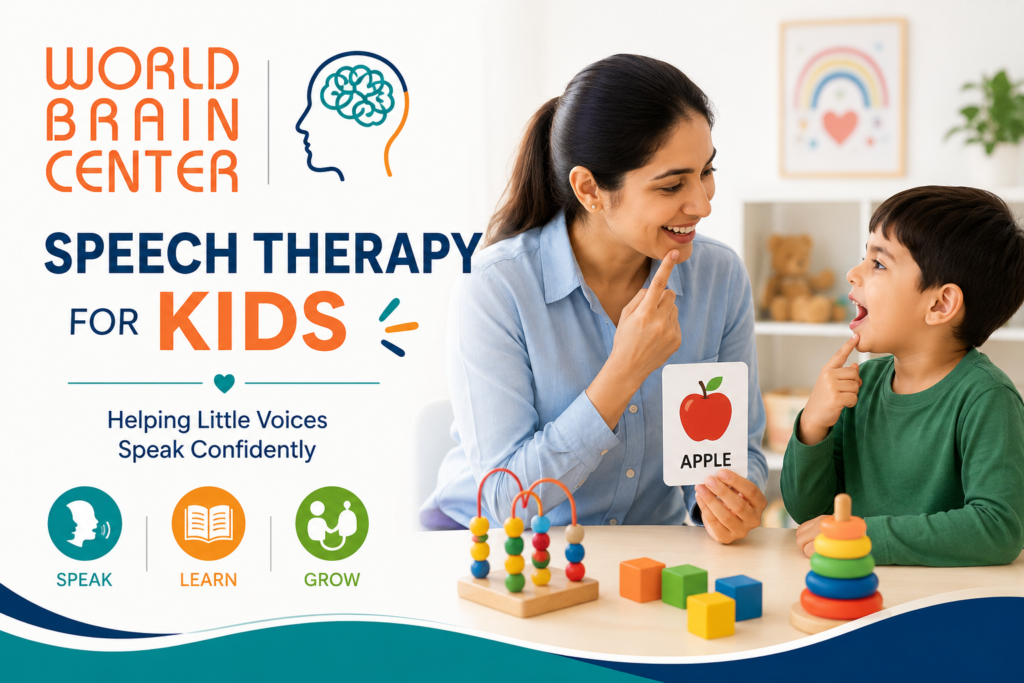
Speech Therapy for Kids: Helping Every Child Speak with Confidence
One of the most heartwarming moments for every parent is hearing their child say their first word. Those tiny milestones—calling “Mama,” asking simple questions, singing rhymes, or sharing stories—are precious memories that parents eagerly await.
But sometimes these milestones arrive later than expected. Some children struggle to pronounce words clearly, while others find it difficult to express themselves or understand conversations. Naturally, parents begin asking themselves:
“Is my child developing normally?”
“Should I wait a little longer?”
“Do we need professional help?”
The good news is that every child develops differently, and a slight delay does not always indicate a serious concern. However, persistent speech or language difficulties should never be ignored because early intervention often leads to significantly better outcomes.
At World Brain Center Hospital, our multidisciplinary team—including the Best Speech Therapist in Delhi, Best Child Psychologist in Delhi, and Best Child Psychiatrist in Delhi—helps children develop effective communication skills through evidence-based, child-friendly therapies designed around each child’s unique strengths and needs.
Whether your child has difficulty speaking, understanding language, stutters while talking, or struggles with social communication, timely speech therapy can build confidence, improve learning, and enhance overall quality of life.
What Is Speech Therapy for Kids?
Speech therapy is a specialized treatment that helps children improve their ability to communicate effectively.
Communication involves much more than simply speaking words.
Children need to learn how to:
- Pronounce sounds correctly
- Understand language
- Build vocabulary
- Form complete sentences
- Express emotions
- Listen attentively
- Communicate socially
- Develop confidence while speaking
Speech therapy combines scientifically proven techniques with fun, play-based learning that encourages children to participate naturally.
Instead of feeling like a classroom lesson, therapy sessions often include:
- Educational games
- Storytelling
- Songs
- Toys
- Picture cards
- Interactive activities
- Conversation practice
Children learn best while enjoying themselves—and speech therapists make every session engaging, encouraging, and age-appropriate.
Why Are Communication Skills So Important?
Communication is one of the most important life skills a child develops.
It influences nearly every aspect of growth, including:
Learning
Children who communicate effectively often understand classroom instructions more easily.
Social Development
Clear communication helps children build friendships and participate confidently in group activities.
Emotional Well-being
Children who struggle to express themselves often experience frustration, sadness, or low confidence.
Academic Success
Language skills directly influence reading, writing, comprehension, and overall academic performance.
Family Relationships
Good communication strengthens connections between children and their parents, siblings, teachers, and caregivers.
Early support allows children to build these essential skills before communication difficulties begin affecting other areas of development.
Common Communication Difficulties in Children
Many parents believe speech therapy is only for children who cannot speak.
In reality, speech therapy addresses a wide variety of communication challenges.
Speech Sound Disorders
Some children struggle to pronounce specific sounds correctly.
Examples include saying:
- “Tat” instead of “Cat”
- “Wabbit” instead of “Rabbit”
- “Pane” instead of “Plane”
These pronunciation difficulties may continue beyond the expected developmental age.
Language Delay
Some children understand conversations but have difficulty expressing themselves.
Others may struggle with both understanding and speaking.
Common signs include:
- Limited vocabulary
- Short sentences
- Difficulty answering questions
- Trouble following instructions
Stammering (Stuttering)
Some children repeat sounds, prolong words, or become “stuck” while speaking.
Although mild stammering can occur during language development, persistent fluency problems benefit from professional evaluation.
Social Communication Difficulties
Some children find it difficult to:
- Take turns during conversations
- Maintain eye contact
- Understand facial expressions
- Interpret body language
- Start conversations
- Make friends
These challenges may occur independently or alongside conditions such as Autism Spectrum Disorder (ASD).
Feeding and Oral Motor Challenges
Speech therapists also help children who experience difficulty with:
- Chewing
- Swallowing
- Tongue movements
- Lip coordination
- Mouth muscle strength
These skills contribute not only to eating but also to clear speech production.
Signs Your Child May Need Speech Therapy
Every child develops at their own pace.
However, certain warning signs should not be ignored.
Consider consulting the Best Speech Therapist in Delhi if your child:
- Does not babble by the expected age.
- Speaks very few words compared to children of the same age.
- Cannot combine two or three words into simple sentences.
- Has speech that is difficult for family members to understand.
- Frequently stutters or repeats sounds.
- Struggles to follow simple instructions.
- Omits sounds while speaking.
- Avoids talking.
- Becomes frustrated while trying to communicate.
- Uses very few gestures such as pointing or waving.
- Has difficulty maintaining eye contact during conversations.
- Prefers gestures instead of spoken language.
Children often understand much more than they can express.
This mismatch between understanding and speaking is one of the most common reasons parents seek professional guidance.
Early assessment provides reassurance—and when intervention is needed, it allows treatment to begin at the most beneficial stage of development.
Why Do Speech Delays Happen?
Speech delays occur for many different reasons.
Some children simply develop language later than others.
Others may have underlying developmental or medical conditions requiring additional support.
Possible causes include:
- Hearing difficulties
- Developmental language disorder
- Autism Spectrum Disorder
- Intellectual developmental disorders
- Neurological conditions
- Premature birth
- Oral motor weakness
- Genetic factors
- Childhood apraxia of speech
- Emotional or environmental factors
Sometimes no single cause is identified.
This is why professional evaluation is important rather than relying on assumptions or comparing your child with others.
Types of Speech Therapy for Children
Every child is unique.
Treatment plans are carefully customized according to the child’s specific communication needs.
Articulation Therapy
This therapy improves pronunciation by teaching children how to correctly position their lips, tongue, and jaw to produce clear speech sounds.
Language Intervention Therapy
Children learn to:
- Build vocabulary
- Form complete sentences
- Improve grammar
- Understand instructions
- Express ideas confidently
Activities include storytelling, books, conversations, and educational games.
Fluency Therapy
Designed for children who stammer or stutter, fluency therapy focuses on:
- Controlled breathing
- Smooth speech techniques
- Confidence building
- Reducing speaking anxiety
Oral Motor Therapy
Exercises strengthen muscles involved in:
- Speaking
- Eating
- Swallowing
- Facial coordination
Social Communication Therapy
Ideal for children experiencing difficulty with social interactions.
Therapists help children learn:
- Turn-taking
- Eye contact
- Emotional understanding
- Conversation skills
- Social confidence
Augmentative and Alternative Communication (AAC)
Some children communicate more effectively using:
- Picture communication systems
- Communication boards
- Sign language
- Speech-generating devices
AAC does not replace speech—it supports communication while language skills continue developing.
What Happens During Speech Therapy Sessions?
Many parents imagine speech therapy as a formal classroom environment.
In reality, therapy sessions are warm, interactive, and designed around play.
A typical therapy journey includes:
Comprehensive Assessment
The speech therapist observes:
- Speech clarity
- Language skills
- Listening ability
- Social interaction
- Developmental milestones
Parents also discuss concerns and developmental history.
Personalized Goal Setting
Every child receives individualized goals based on their assessment.
Examples include:
- Producing certain speech sounds
- Expanding vocabulary
- Building longer sentences
- Improving conversation skills
- Increasing confidence
Interactive Therapy Sessions
Children participate in engaging activities such as:
- Storybooks
- Educational games
- Picture cards
- Music
- Toys
- Role-play
- Interactive conversations
Learning remains enjoyable while communication skills improve naturally.
Parent Participation
Parents play a vital role in therapy success.
Speech therapists provide simple home activities so children continue practicing outside therapy sessions.
This partnership significantly accelerates progress.
Benefits of Early Speech Therapy: Why Acting Early Makes a Difference
One of the biggest misconceptions parents have is believing that their child will eventually “catch up” without intervention. While some children naturally develop speech and language skills later than others, persistent communication difficulties should never be ignored.
Research consistently shows that early intervention produces the best outcomes because a young child’s brain is highly adaptable during the early developmental years. This period, often called the “window of opportunity,” allows children to learn communication skills more quickly and effectively.
At World Brain Center Hospital, our specialists encourage parents not to wait if they notice delays. Starting Speech Therapy for Kids early can improve not only speech but also confidence, learning ability, emotional well-being, and social development.
Early Speech Therapy Helps Children:
Build Clearer Speech
Children gradually learn correct pronunciation, making it easier for others to understand them.
Improve Language Skills
Therapy helps children expand their vocabulary, understand conversations, ask questions, and express their thoughts more confidently.
Develop Better Social Skills
Communication is the foundation of friendships. Children who communicate effectively are more likely to participate in group activities, make friends, and develop positive relationships.
Reduce Frustration
Many children become upset simply because they cannot explain what they want or how they feel.
Improved communication significantly reduces tantrums, emotional outbursts, and withdrawal.
Prepare for School
Speech and language skills directly influence:
- Reading
- Writing
- Listening
- Classroom participation
- Academic confidence
Early intervention creates a strong foundation for future learning.
Simple Speech Therapy Activities Parents Can Practice at Home
Speech therapy doesn’t stop when a child leaves the clinic.
Parents play one of the most important roles in supporting communication development.
Small daily interactions often create the biggest improvements.
Read Together Every Day
Reading picture books introduces children to:
- New vocabulary
- Sentence formation
- Listening skills
- Storytelling
Ask simple questions while reading:
“What is the dog doing?”
“What colour is the ball?”
“Can you point to the apple?”
Talk About Everyday Activities
Narrate daily routines.
Instead of remaining silent while cooking or getting dressed, describe your actions.
Examples:
- “Let’s wash your hands.”
- “We’re cutting the apple.”
- “Your shoes are blue.”
- “Let’s open the door.”
This naturally increases language exposure.
Sing Songs and Nursery Rhymes
Music helps children learn:
- Rhythm
- Pronunciation
- Memory
- Sentence patterns
Repeated songs encourage participation and make learning enjoyable.
Give Choices
Instead of asking broad questions like:
“What do you want?”
Try:
“Do you want milk or juice?”
“Would you like the red toy or the blue toy?”
Children become more motivated to respond verbally.
Limit Passive Screen Time
Television and mobile devices cannot replace real conversations.
Interactive communication with parents, grandparents, siblings, and friends contributes far more to language development.
Play Interactive Games
Simple games such as:
- Building blocks
- Pretend cooking
- Animal sounds
- Matching pictures
- Puzzles
- Flashcards
encourage natural conversation while keeping children engaged.
Celebrate Every Attempt
Praise effort rather than perfection.
Instead of correcting every mistake, encourage communication by saying:
“Great job telling me!”
“I understood you!”
“Let’s say it together.”
Positive reinforcement builds confidence.
Common Mistakes Parents Should Avoid
Parents naturally want the best for their children, but some well-intentioned habits may unintentionally slow communication development.
Avoid:
❌ Comparing your child with other children.
❌ Speaking for your child all the time.
❌ Correcting every word repeatedly.
❌ Rushing conversations.
❌ Ignoring communication difficulties hoping they disappear.
❌ Forcing the child to speak under pressure.
Children develop communication best when they feel safe, relaxed, and encouraged.
When Should You Consult a Speech Therapist?
Professional assessment is recommended if your child:
- Has limited speech for their age.
- Cannot understand simple instructions.
- Frequently stutters.
- Avoids speaking.
- Shows frustration while communicating.
- Has difficulty interacting socially.
- Experiences delayed language milestones.
- Is diagnosed with Autism Spectrum Disorder (ASD), ADHD, hearing impairment, or developmental delay.
Early evaluation does not necessarily mean something is seriously wrong.
Often, it simply provides reassurance and guidance that helps children thrive.
Why Choose World Brain Center Hospital?
At World Brain Center Hospital, we believe every child deserves the opportunity to communicate confidently and reach their full potential.
Our multidisciplinary Child Development Team includes:
- Best Speech Therapist in Delhi
- Best Child Psychologist in Delhi
- Best Child Psychiatrist in Delhi
- Occupational Therapists
- Behaviour Therapists
- Developmental Specialists
- Child Counsellors
Our comprehensive services include:
✔ Speech & Language Assessment
✔ Speech Therapy for Kids
✔ Language Delay Treatment
✔ Autism Communication Therapy
✔ Stammering & Fluency Therapy
✔ Oral Motor Therapy
✔ Feeding Therapy
✔ Social Communication Skills Training
✔ Child Behaviour Therapy
✔ Parent Guidance Programs
Every treatment plan is personalized according to your child’s developmental needs, ensuring compassionate, evidence-based, and family-centred care.
Every Child Has a Voice—Sometimes They Just Need Help Finding It
Watching your child struggle to communicate can feel overwhelming, but remember—you are not alone.
With early intervention, professional guidance, and consistent support at home, children can make remarkable progress in their communication skills.
Every new word…
Every clear sentence…
Every confident conversation…
is a milestone worth celebrating.
At World Brain Center Hospital, our mission is to help every child find their voice, build confidence, and communicate with the world around them.
Contact World Brain Center Hospital
📍 World Brain Center Hospital, Delhi
📞 011-41643347
📞 9968788861 | 9968788865 | 9968788867
Book an expert consultation today with the Best Speech Therapist in Delhi and our experienced Child Development Team.
Frequently Asked Questions (FAQs)
1. At what age should my child start speech therapy?
There is no fixed age for starting speech therapy. If your child is missing important speech or language milestones or you notice communication delays, it is best to seek an early assessment. Early intervention often leads to faster and more effective progress.
2. How long does speech therapy take to show results?
Every child progresses differently depending on their age, the nature of the speech or language difficulty, and regular practice at home. Some children improve within a few months, while others benefit from longer-term therapy.
3. Can parents help improve speech at home?
Yes. Reading together, talking during daily routines, singing songs, playing interactive games, limiting passive screen time, and practicing activities suggested by the speech therapist can significantly support your child’s communication development.
4. Why choose World Brain Center Hospital for Speech Therapy for Kids?
World Brain Center Hospital offers comprehensive child development services with experienced speech therapists, child psychologists, child psychiatrists, and multidisciplinary specialists. Our evidence-based, play-based, and family-centred approach helps children build strong communication skills while improving confidence, learning, and overall development.
Disclaimer
This article is intended for educational purposes only and should not replace professional medical advice, diagnosis, or treatment. Every child’s developmental journey is unique, and speech or language delays can have different causes. If you have concerns about your child’s communication, consult a qualified speech therapist or child development specialist. At World Brain Center Hospital, our experienced team provides personalized assessments and evidence-based therapies to support every child’s communication, learning, and overall well-being.
