
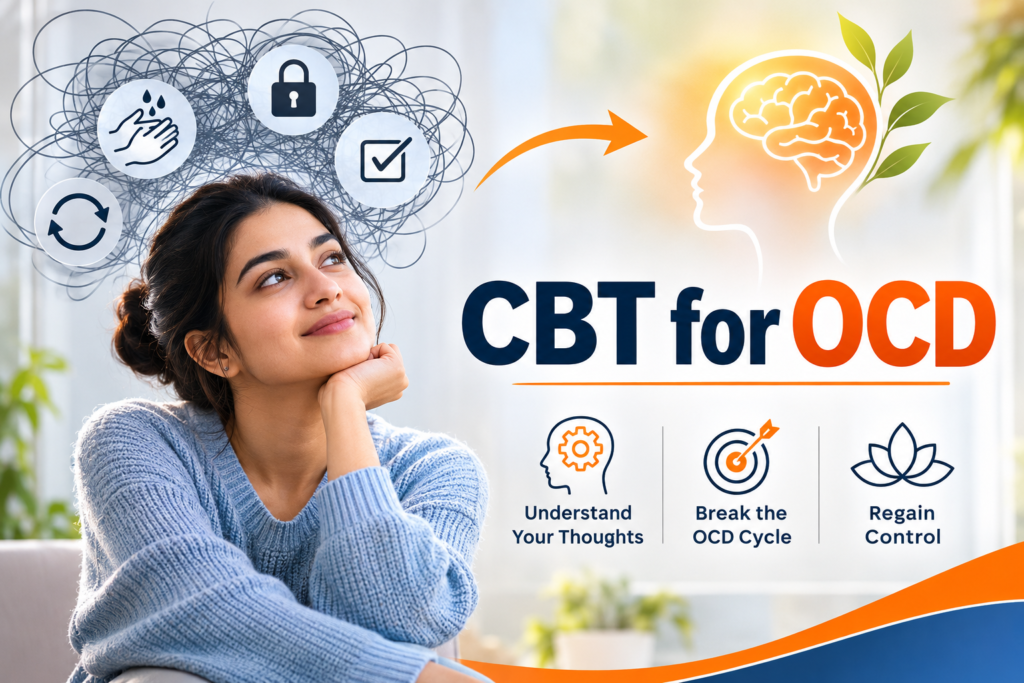
CBT for OCD: Understanding the Therapy That Helps Break the Cycle of Obsessions and Compulsions
Imagine checking whether the front door is locked five or six times before leaving home. You know you have already checked it, yet an uncomfortable feeling keeps telling you to check again. Or perhaps you repeatedly wash your hands because you cannot shake the feeling that they are contaminated, even when there is no visible dirt.
For someone living with Obsessive-Compulsive Disorder (OCD), these experiences can become exhausting. What may appear to others as a simple habit can involve intense anxiety, unwanted thoughts, repeated behaviours, and a constant struggle to feel reassured.
OCD is more than being organised, particular, or perfectionistic. It is a mental health condition that can interfere with everyday activities, relationships, professional responsibilities, and emotional well-being.
One of the most widely recommended psychological treatments for OCD is Cognitive Behavioural Therapy (CBT), particularly a specialised approach called Exposure and Response Prevention (ERP).
CBT helps individuals understand their thought patterns, manage anxiety, and gradually change the behaviours that keep OCD going.
At World Brain Center Hospital, our mental healthcare approach focuses on understanding each individual’s symptoms and providing appropriate psychological and psychiatric support.
What Is Cognitive Behavioural Therapy for OCD?
Cognitive Behavioural Therapy is an evidence-based psychological treatment that explores how thoughts, emotions, and behaviours influence one another.
People experiencing OCD often find themselves trapped in a repetitive cycle:
- An unwanted or intrusive thought appears.
- The thought creates anxiety, fear, guilt, or discomfort.
- The individual performs a repetitive action or mental ritual to reduce the distress.
- Temporary relief follows.
- The thought returns, and the cycle begins again.
For example, someone may repeatedly worry that they have left an electrical appliance switched on. Even after checking it, they may continue experiencing doubt and feel compelled to check again.
CBT helps individuals recognise this pattern and understand that having an unwanted thought does not mean something bad will happen.
Rather than trying to eliminate every uncomfortable thought, therapy teaches individuals to respond differently to these thoughts without automatically performing compulsions.
Two important components of this treatment are:
- Cognitive Therapy: Identifying and challenging unhelpful beliefs, interpretations, and thinking patterns.
- Exposure and Response Prevention (ERP): Gradually facing anxiety-provoking situations while learning to resist compulsive responses.
Together, these approaches help individuals develop healthier ways of managing uncertainty and anxiety.
How Does CBT Work for OCD?
OCD often makes individuals feel that they must perform certain actions to prevent something unpleasant from happening.
For example:
- Checking the door repeatedly to prevent a possible burglary.
- Washing hands repeatedly because of contamination fears.
- Arranging objects until everything feels perfectly symmetrical.
- Repeating certain words mentally to prevent imagined harm.
- Seeking reassurance from family members to feel temporarily comfortable.
The difficulty is that compulsions provide only short-term relief. Over time, the brain may become increasingly dependent on these behaviours.
CBT works by helping individuals gradually break this association.
1. Understanding Intrusive Thoughts
Intrusive thoughts are unwanted thoughts, images, or urges that enter the mind without invitation.
They can involve contamination, harm, religion, relationships, sexuality, safety, or other distressing subjects.
Having an intrusive thought does not mean someone wants to act on it or that it reflects their personality.
CBT helps individuals understand that thoughts are mental experiences, not necessarily facts, intentions, or predictions.
2. Changing Unhelpful Thinking Patterns
People with OCD may experience excessive responsibility, fear of uncertainty, or an overwhelming need for reassurance.
Cognitive restructuring helps identify these thinking patterns and develop more balanced interpretations.
For example, instead of thinking, “If I do not check the lock again, something terrible will happen,” an individual gradually learns to recognise that uncertainty does not automatically indicate danger.
3. Breaking Compulsive Behaviour
CBT helps individuals understand why repetitive behaviours continue and how to reduce their dependence on them.
With professional guidance, individuals practise responding differently when anxiety appears.
The objective is not to achieve perfect certainty but to develop confidence in managing uncomfortable feelings without performing rituals.
What Is Exposure and Response Prevention (ERP)?
Exposure and Response Prevention is a specialised form of CBT considered a first-line psychological treatment for OCD.
It involves gradually confronting situations, thoughts, or objects that trigger obsessive anxiety while learning not to perform the associated compulsions.
For example, an individual who repeatedly checks door locks may gradually practise checking once and then moving on with their routine.
Similarly, someone experiencing contamination fears may work with their therapist to gradually reduce unnecessary washing behaviours.
ERP is not about forcing someone into frightening situations. Exposures are planned collaboratively with the therapist and adjusted according to the individual’s needs and readiness.
How ERP Helps Manage OCD
- Reduces dependence on compulsive behaviours.
- Improves tolerance of uncertainty.
- Helps individuals face feared situations.
- Builds confidence in managing anxiety.
- Reduces the interference of OCD in everyday activities.
With repeated practice, individuals can learn that anxiety can be tolerated without automatically performing compulsions.
Common CBT Techniques Used in OCD Treatment
CBT is not a one-size-fits-all treatment. The techniques used depend on the individual’s symptoms, severity, emotional needs, and treatment goals.
1. Exposure and Response Prevention
ERP involves gradually confronting triggers while resisting compulsions. It helps individuals develop healthier responses to obsessive fears.
2. Cognitive Restructuring
This technique helps individuals recognise exaggerated fears, unrealistic assumptions, and unhelpful beliefs.
The therapist encourages more balanced and practical ways of interpreting situations.
3. Fear Hierarchy
A fear hierarchy, sometimes called a fear ladder, is a list of situations arranged according to the anxiety they create.
Therapists use this approach to plan gradual exposure exercises, beginning with manageable challenges and progressing according to the treatment plan.
4. Mindfulness and Thought Awareness
Mindfulness helps individuals observe thoughts without immediately reacting to them.
Rather than fighting every unwanted thought, individuals learn to acknowledge its presence and return their attention to the activity they were performing.
5. Behavioural Experiments
These exercises help individuals examine their assumptions through planned experiences.
For example, a person who believes that checking something repeatedly is necessary may gradually test alternative responses with professional guidance.
These techniques work together to improve emotional flexibility and reduce the influence of OCD symptoms.
What Happens During CBT Sessions for OCD?
Starting psychological treatment can feel intimidating, particularly when someone has been struggling with unwanted thoughts for a long time.
However, CBT sessions are generally structured, collaborative, and focused on the individual’s comfort and treatment goals.
A typical treatment journey may include:
Initial Psychological Assessment
The psychologist understands the individual’s symptoms, intrusive thoughts, compulsions, emotional difficulties, and their impact on everyday life.
Identifying OCD Patterns
The therapist helps identify specific triggers, repetitive behaviours, avoidance patterns, and beliefs that maintain the OCD cycle.
Developing a Personalised Treatment Plan
A treatment plan is prepared according to the individual’s needs, symptoms, and readiness for therapy.
Gradual Exposure Exercises
When appropriate, ERP exercises are introduced progressively. Individuals learn to manage anxiety without relying on compulsions.
Practice Between Sessions
Therapists may suggest exercises to practise at home. Consistency helps individuals apply the skills learned during sessions to real-life situations.
Monitoring Progress
Progress is reviewed regularly, and treatment strategies are adjusted whenever necessary.
It is important to remember that treatment is collaborative. Individuals should be encouraged to communicate their concerns and discuss any exercise that feels overwhelming.
How Long Does CBT Take to Show Results?
There is no fixed timeline for OCD recovery.
Some individuals begin noticing improvements within the initial weeks of structured therapy, while others require a longer treatment period depending on symptom severity, duration, and associated mental health concerns.
Progress may include:
- Better understanding of intrusive thoughts.
- Reduced time spent performing compulsions.
- Improved ability to manage anxiety.
- Less dependence on reassurance.
- Greater confidence in everyday activities.
- Improved relationships and professional functioning.
There may also be difficult days during treatment. Occasional setbacks do not mean therapy has failed.
Consistency, professional guidance, and regular practice are important for maintaining progress.
Benefits of Cognitive Behavioural Therapy for OCD
CBT offers practical skills that individuals can continue using even after completing formal therapy.
Some important benefits include:
Reduced Compulsive Behaviour: Individuals learn to manage urges without repeatedly performing rituals.
Better Emotional Regulation: Therapy helps develop healthier responses to anxiety, fear, and uncertainty.
Improved Daily Functioning: Reduced interference from OCD can make it easier to focus on work, studies, and personal responsibilities.
Healthier Relationships: Family members may better understand OCD, while individuals become less dependent on reassurance.
Increased Self-Confidence: Learning to manage difficult thoughts can strengthen confidence and independence.
Long-Term Coping Skills: Individuals develop strategies to recognise triggers and respond to them more effectively.
The objective is not to create a mind without unwanted thoughts. It is to help individuals live meaningful lives without allowing OCD to control their decisions.
Who Should Consider CBT for OCD?
CBT, particularly ERP, may be suitable for individuals experiencing:
- Repeated unwanted or intrusive thoughts.
- Excessive handwashing or cleaning.
- Repeated checking behaviours.
- Fear of contamination.
- Persistent doubts and reassurance-seeking.
- A strong need for symmetry or order.
- Mental rituals or repetitive counting.
- Distressing religious or moral obsessions.
- Relationship-related obsessive doubts.
- Compulsions that interfere with everyday activities.
If these experiences are causing distress or affecting daily functioning, a professional assessment can help determine whether OCD is present and which treatment approach is appropriate.
People experiencing severe symptoms or additional conditions such as depression, anxiety, or substance dependence may require combined psychological and psychiatric care.
Can OCD Be Treated Without Medication?
Some individuals with OCD improve through structured psychological treatment, particularly CBT with ERP.
However, medication may also be recommended depending on symptom severity, individual circumstances, treatment response, and associated conditions.
Psychiatrists may prescribe medications such as Selective Serotonin Reuptake Inhibitors (SSRIs) when clinically appropriate.
The decision to use medication should always be made by a qualified psychiatrist after an individual assessment.
Psychotherapy and medication can also be used together when necessary.
Individuals should never discontinue prescribed medication or change their dosage without consulting their treating doctor.
Why Choose World Brain Center Hospital for OCD Treatment?
Finding the right mental healthcare professional is an important step towards managing OCD.
World Brain Center Hospital provides comprehensive psychiatric and psychological care for individuals experiencing OCD and other mental health conditions.
Our approach focuses on understanding the individual rather than treating every patient with the same strategy.
Our mental healthcare services include:
- Psychiatric Assessment and Consultation.
- Psychological Assessment.
- Cognitive Behavioural Therapy (CBT).
- Exposure and Response Prevention (ERP), where clinically appropriate.
- Anxiety and Depression Management.
- Obsessive-Compulsive Disorder Management.
- Individual Counselling.
- Family Counselling.
- Child and Adolescent Mental Healthcare.
- De-Addiction and Rehabilitation Support.
Our multidisciplinary approach helps individuals access appropriate psychological and psychiatric guidance according to their clinical needs.
Whether OCD symptoms have recently started or have been affecting daily life for years, seeking professional guidance can be an important step towards improvement.
Take the First Step Towards Managing OCD
Living with OCD can be emotionally exhausting. Repeated thoughts, constant doubts, and compulsive behaviours may make even simple daily activities feel difficult.
But OCD does not have to define your life.
With appropriate assessment, evidence-based therapy, and consistent support, individuals can learn to manage intrusive thoughts, reduce compulsions, and regain confidence in their everyday decisions.
At World Brain Center Hospital, we believe that every individual deserves compassionate care, professional guidance, and the opportunity to experience a better quality of life.
You do not have to fight every thought. You can learn to change how you respond to it.
Contact World Brain Center Hospital
World Brain Center Hospital, Delhi
Phone: 011-41643347
Appointments: 9968788861 | 9968788865 | 9968788867
Connect with our mental healthcare team for professional guidance and an appropriate OCD treatment assessment.
Frequently Asked Questions (FAQs)
1. How does Cognitive Behavioural Therapy help in treating OCD?
Cognitive Behavioural Therapy helps individuals understand the relationship between obsessive thoughts, anxiety, and compulsive behaviours. It teaches practical strategies to challenge unhelpful beliefs and manage intrusive thoughts. ERP, a specialised form of CBT, helps individuals gradually face triggers without performing compulsions.
2. Is Exposure and Response Prevention (ERP) necessary for OCD treatment?
ERP is one of the most effective and widely recommended psychological treatments for OCD. It helps individuals gradually confront anxiety-provoking situations while learning to resist compulsive behaviours. The treatment is personalised according to individual symptoms and readiness.
3. How long does CBT take to reduce OCD symptoms?
The duration varies depending on symptom severity, individual progress, and treatment consistency. Some people notice improvements within a few weeks, while others require several months of structured therapy. Regular practice and professional follow-up are important.
4. Can OCD be treated permanently with CBT without medication?
CBT with ERP can provide significant and lasting improvement for many individuals. Some people manage their symptoms effectively without medication, while others benefit from combining therapy with psychiatric treatment. The appropriate approach depends on individual clinical assessment and should be decided with a qualified mental health professional.
Medical Disclaimer
This article is intended for general educational and mental health awareness purposes. It does not replace professional medical advice, psychological assessment, diagnosis, or treatment. OCD symptoms and treatment requirements vary between individuals. Please consult a qualified psychiatrist or clinical psychologist for personalised guidance. Never start, stop, or modify prescribed medication without medical advice.
World Brain Center Hospital encourages individuals experiencing obsessive thoughts, repetitive behaviours, or emotional distress to seek timely professional support.