
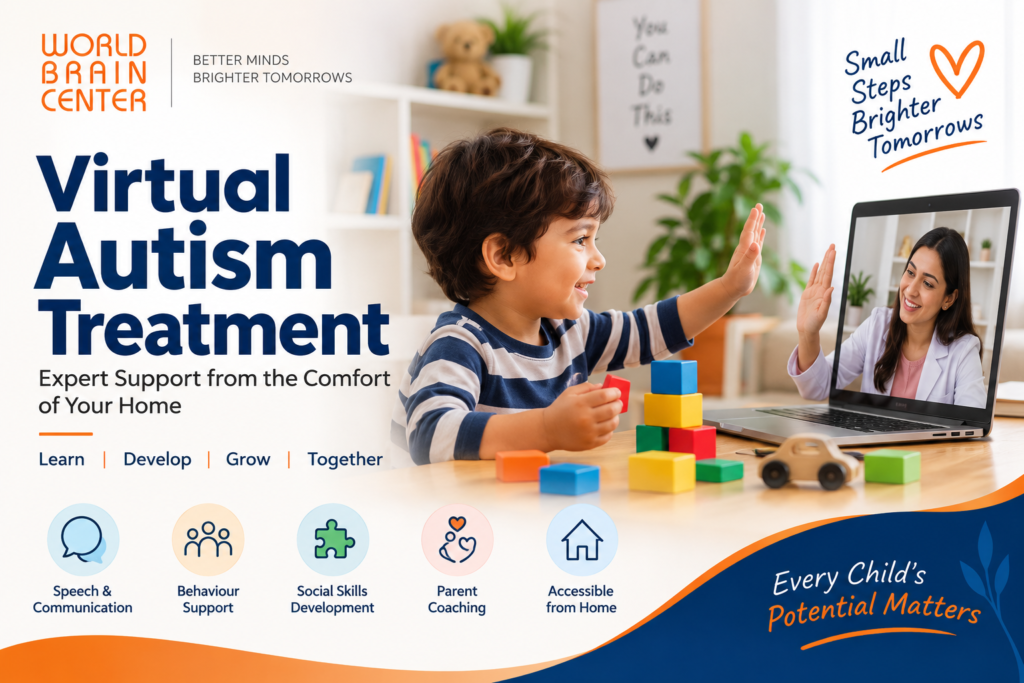
Virtual Autism Treatment: A Practical Guide for Parents
When a child is not speaking as expected, avoids eye contact, struggles to engage in play, or spends a significant amount of time on screens, parents naturally become concerned.
One of the terms parents may encounter online is “virtual autism.” It is important to understand what this term does—and does not—mean.
Virtual autism is not a formal clinical diagnosis of Autism Spectrum Disorder (ASD). Developmental concerns that appear alongside high screen exposure should not automatically be assumed to be caused by screens or labelled as autism. A child with delayed speech, reduced social interaction, repetitive behaviours, or developmental differences needs an appropriate assessment to understand what is actually happening.
Autism Spectrum Disorder is a neurodevelopmental condition diagnosed through a child’s developmental history, behaviour, communication, social interaction, and professional observation. There is no single blood test or online quiz that can diagnose autism.
This distinction is extremely important because early developmental concerns deserve attention regardless of their cause.
For families who cannot regularly travel to a specialist, virtual autism treatment or online developmental therapy can sometimes provide valuable support. Telehealth can be particularly useful for parent coaching, behavioural interventions, speech and communication support, and follow-up care when the child is suitable for remote sessions. The American Academy of Pediatrics describes telehealth models for developmental assessment and parent/caregiver-mediated intervention, including autism-related services.
What Does “Virtual Autism” Mean?
The phrase virtual autism is sometimes used online to describe autism-like or developmental difficulties that parents associate with prolonged or excessive screen exposure in young children.
These may include:
- Delayed or limited speech
- Reduced social interaction
- Difficulty sustaining attention
- Limited eye contact
- Reduced interest in interactive play
- Difficulty following instructions
- Strong preference for screens
- Repetitive or restricted play patterns
However, these behaviours do not automatically mean a child has autism—or that screens have caused autism.
Some of these characteristics can occur in children who do not have ASD and may also be associated with speech-language delays, hearing problems, developmental differences, attention difficulties, environmental factors, or other conditions.
Autism itself is characterized by differences in social communication and interaction together with restricted or repetitive behaviours or interests.
Therefore, the right question is not simply:
“Does my child have virtual autism?”
A more useful question is:
“What is causing my child’s developmental difficulties, and what support does my child need?”
That is where professional developmental assessment becomes important.
Virtual Autism vs Autism Spectrum Disorder
Understanding this distinction can prevent unnecessary anxiety and delayed treatment.
Virtual Autism
“Virtual autism” is an informal term rather than a recognized diagnostic category. It is commonly used in discussions about developmental concerns associated with high screen exposure.
Autism Spectrum Disorder
ASD is a clinically recognized neurodevelopmental condition. Diagnosis requires a comprehensive assessment of developmental history and behaviour rather than simply observing screen use or a few isolated symptoms.
A child should therefore never be diagnosed with autism—or ruled out from having autism—simply because they use screens frequently.
If developmental concerns are present, an experienced Best Child Psychiatrist in Delhi, developmental specialist, psychologist, speech-language professional, or other qualified clinician may be involved depending on the child’s needs.
Signs Parents Should Pay Attention To
Every child develops at their own pace, but persistent developmental concerns deserve professional attention.
Parents may notice:
Communication Concerns
- Limited vocabulary
- Delayed speech
- Difficulty expressing needs
- Limited back-and-forth communication
- Difficulty responding appropriately to questions
Social Interaction Concerns
- Limited eye contact
- Reduced response to name
- Limited interest in interactive play
- Difficulty sharing attention with another person
- Reduced engagement with family members
Behavioural Concerns
- Repetitive movements or play
- Strong distress when routines change
- Unusually intense interests
- Difficulty transitioning between activities
- Repeatedly focusing on one type of activity
These signs are not enough by themselves to establish an autism diagnosis. Some children without ASD can show one or more of these behaviours. A professional evaluation is needed to understand the overall developmental picture.
Why Early Developmental Assessment Matters
Parents sometimes wait because they hope a child will “catch up naturally.”
Sometimes children do develop skills later. But persistent concerns should not simply be ignored.
The CDC notes that developmental monitoring and screening can help identify children who may need further assessment, and autism-specific screening is recommended during routine well-child care at 18 and 24 months.
Early assessment can help identify:
- Speech and language delays
- Social communication difficulties
- Developmental delays
- Behavioural concerns
- Hearing-related issues
- Attention difficulties
- Autism-related characteristics
- Other developmental or psychological concerns
The objective is not to place a label on a child.
The objective is to understand the child and provide appropriate support as early as possible.
What Is Virtual Autism Therapy?
Virtual autism therapy refers to professionally guided developmental or behavioural support delivered remotely using secure video-based platforms and other digital tools.
Depending on the child’s needs and the clinician’s assessment, online sessions may include:
- Parent coaching
- Behavioural interventions
- Speech and communication activities
- Social-communication training
- Developmental skill-building
- Behaviour management guidance
- Caregiver education
- Follow-up consultations
The American Academy of Pediatrics has documented telehealth models that use parent/caregiver-mediated interventions for children with autism and other developmental-behavioural conditions. These models can allow professionals to coach caregivers while observing the child in their natural home environment.
What Can Online Autism Therapy Include?
There is no single virtual therapy program suitable for every child. Treatment should be based on the child’s developmental profile and individual goals.
1. Online ABA-Based Intervention
When clinically appropriate, behaviour-based interventions can be delivered through telehealth with active caregiver participation.
Goals may include:
- Improving communication
- Following instructions
- Developing functional skills
- Managing transitions
- Building appropriate behaviours
- Improving self-regulation
The therapist establishes measurable goals and reviews progress regularly.
2. Virtual Speech and Language Support
Children with communication difficulties may benefit from remote speech-language sessions when the format is appropriate for their age and needs.
Parents can learn practical techniques to encourage communication during:
- Mealtimes
- Play
- Reading
- Bathing
- Getting dressed
- Everyday conversations
The advantage is that parents can immediately practise the strategies in the child’s normal environment.
3. Parent-Mediated Intervention
Parents are not simply observers.
They can become an important part of the intervention team.
A therapist may demonstrate how to:
- Encourage communication
- Follow the child’s interests
- Create opportunities for requesting
- Support joint attention
- Reinforce appropriate behaviour
- Encourage interactive play
- Manage transitions
Evidence from systematic reviews suggests parent-mediated interventions may provide benefits in some areas, although the strength of evidence varies across outcomes and more high-quality research is needed.
4. Social-Communication Training
Some children need additional support with:
- Taking turns
- Sharing
- Responding to others
- Understanding facial expressions
- Recognizing emotions
- Participating in conversations
- Interactive play
Depending on the child’s age and abilities, therapists may use role-play, modelling, visual supports, and guided activities.
5. Occupational Therapy Support
Certain occupational therapy goals may be supported through home-based guidance or teletherapy when clinically appropriate.
These may involve:
- Fine-motor activities
- Self-care skills
- Sensory regulation strategies
- Hand-eye coordination
- Daily living activities
However, some occupational therapy needs require hands-on assessment and intervention. In such cases, an in-person appointment may be more appropriate.
Can Screen Time Cause Autism?
This is one of the most important questions parents ask.
Current clinical guidance does not support describing screen exposure as a cause of Autism Spectrum Disorder.
A child showing developmental difficulties after extensive screen use should not automatically be assumed to have “screen-induced autism.”
At the same time, managing sedentary screen exposure is an important part of healthy early childhood routines. WHO recommends limiting sedentary screen time for young children, with specific recommendations for children under five. For example, WHO recommends no sedentary screen time for 1-year-olds and no more than one hour for 2-year-olds, with less being better; for children aged 3–4, the recommendation is no more than one hour.
For parents, the practical message is:
Reduce excessive recreational screen exposure, increase real-world interaction, and seek developmental assessment when concerns persist.
Creating a Healthier Home Environment
Parents can support development through everyday activities.
Talk More
Narrate what you are doing:
“Let’s wash your hands.”
“Here is your red ball.”
“We are going outside.”
This creates natural opportunities for language exposure.
Read Together
Shared reading encourages:
- Vocabulary
- Attention
- Listening
- Turn-taking
- Interaction
Encourage Interactive Play
Choose activities that require participation rather than passive viewing.
Spend Time Outdoors
Outdoor play provides opportunities for movement, exploration, sensory experiences, and social interaction.
Make Mealtimes Interactive
Whenever practical, keep meals focused on family interaction rather than screens.
Follow a Predictable Routine
Consistent routines can help children understand what comes next and manage transitions more comfortably.
How Parents Can Support Online Therapy
Successful teletherapy requires active caregiver participation.
Parents can:
- Prepare a quiet therapy space
- Keep necessary toys or materials ready
- Follow therapist instructions
- Practise recommended activities between sessions
- Track developmental changes
- Share concerns honestly
- Attend follow-up appointments
- Maintain consistent routines
Telehealth can sometimes give therapists an opportunity to observe parent-child interactions in the child’s natural environment, which can provide useful context for caregiver coaching.
Benefits of Virtual Autism Treatment
For suitable children and families, online therapy can offer several practical advantages.
Accessibility
Families who live far from specialist services may be able to connect with qualified professionals remotely.
Convenience
Parents can avoid frequent travel and arrange sessions around school, work, and family routines.
Parent Participation
Caregivers can learn strategies directly from therapists and practise them at home.
Continuity
Remote follow-up can help maintain contact between in-person appointments when clinically appropriate.
Real-World Coaching
Therapists may sometimes observe the child’s behaviour within their normal home environment.
The AAP has reported telehealth developmental models that improved access to services and reduced travel demands for some families.
When Is In-Person Autism Assessment or Therapy Necessary?
Virtual care is not a replacement for every type of developmental assessment or therapy.
An in-person evaluation may be important when:
- A comprehensive autism assessment is required
- The diagnosis remains unclear
- Hearing or neurological concerns need assessment
- There are significant motor difficulties
- Hands-on sensory assessment is necessary
- The child cannot engage effectively through video
- Severe behavioural concerns cannot be managed safely remotely
- Progress remains limited despite appropriate teletherapy
- The child needs an intervention that requires direct physical support
A hybrid model—combining online parent coaching with periodic in-person assessment or therapy—may be appropriate for some families.
Is There a Cure for Autism?
There is no scientifically established cure for Autism Spectrum Disorder.
Autism is a neurodevelopmental condition, and support focuses on helping each child develop communication, learning, adaptive, social, and functional skills according to their individual needs.
Similarly, parents should be cautious about websites or programs promising a guaranteed “cure for virtual autism.”
The focus should be on:
Assessment → Understanding → Individualized Intervention → Parent Support → Progress Monitoring
Choosing the Right Autism Specialist
When searching for the Best Autism Doctors Delhi, parents should look beyond marketing claims.
Consider whether the professional:
- Has appropriate qualifications and experience
- Conducts a comprehensive developmental assessment
- Explains findings clearly
- Works with a multidisciplinary team when necessary
- Sets measurable treatment goals
- Involves parents or caregivers
- Monitors progress
- Recommends in-person evaluation when required
- Avoids unsupported claims about “curing” autism
At World Brain Center Hospital, developmental and behavioural concerns can be evaluated within a broader mental-health and child-development framework, with referrals or multidisciplinary input when required.
How World Brain Center Hospital Can Help
World Brain Center Hospital provides mental health and child-focused clinical services designed around individual needs.
Families seeking support for developmental concerns may benefit from evaluation and guidance involving appropriate specialists, including:
- Child psychiatrists
- Psychologists
- Behavioural professionals
- Speech and language professionals, where available or referred
- Other developmental specialists as clinically indicated
Our approach focuses on understanding the child rather than relying on a single symptom or label.
If you are concerned about your child’s speech, social interaction, behaviour, screen use, attention, or developmental progress, professional guidance can help you understand the next appropriate step.
World Brain Center Hospital
📞 011-41643347
📞 9968788861 | 9968788865 | 9968788867
Frequently Asked Questions
1. What is virtual autism treatment?
Virtual autism treatment refers to remote developmental and behavioural support delivered through secure video sessions and caregiver coaching. Depending on the child’s needs, it may include behavioural intervention, communication support, social-skills training, and parent-mediated strategies. It should not be confused with a formal diagnosis called “virtual autism.”
2. Is virtual autism the same as Autism Spectrum Disorder?
No. “Virtual autism” is an informal term and is not a formal diagnosis of ASD. Autism Spectrum Disorder is a clinically diagnosed neurodevelopmental condition requiring an appropriate developmental and behavioural assessment.
3. Can online ABA therapy be provided at home?
Yes, some ABA-based interventions can be delivered through telehealth when the child is suitable for remote sessions and caregivers can actively participate. Some goals may still require in-person assessment or intervention.
4. Does too much screen time cause autism?
Current clinical evidence does not support describing screen exposure as a cause of Autism Spectrum Disorder. However, excessive sedentary screen time can displace important activities such as sleep, physical activity, shared reading, play, and face-to-face interaction, so age-appropriate screen habits are important.
5. When should parents consult a child psychiatrist or autism specialist?
Parents should seek professional advice when they notice persistent speech delays, reduced social interaction, difficulty responding to their name, repetitive behaviours, loss of previously acquired skills, or other developmental concerns. Early assessment can help determine whether further evaluation or intervention is needed.
6. Can virtual therapy replace in-person autism treatment?
Not always. Virtual therapy can be useful for selected interventions and parent coaching, but some children need direct developmental, sensory, medical, or behavioural assessment. A hybrid approach may be appropriate depending on the child’s needs.
Final Takeaway
If your child spends a lot of time on screens and you have noticed changes in speech, communication, attention, play, or social interaction, don’t panic and don’t self-diagnose.
Reducing excessive recreational screen time, increasing meaningful interaction, and speaking with a qualified professional are sensible first steps.
Most importantly, don’t wait for a label before seeking help.
Every child deserves to be understood as an individual.
Disclaimer
This article is intended for general education and awareness. It does not diagnose autism, “virtual autism,” developmental delay, or any other condition, and it should not replace professional medical or developmental assessment. Treatment suitability varies from child to child. If you have concerns about your child’s development, consult a qualified child psychiatrist, psychologist, developmental specialist, or appropriate healthcare professional.
World Brain Center Hospital can help families understand developmental and behavioural concerns and identify appropriate next steps based on the child’s individual needs.