
ERP Therapy for OCD: A Practical Guide to Exposure, Response Prevention and Recovery
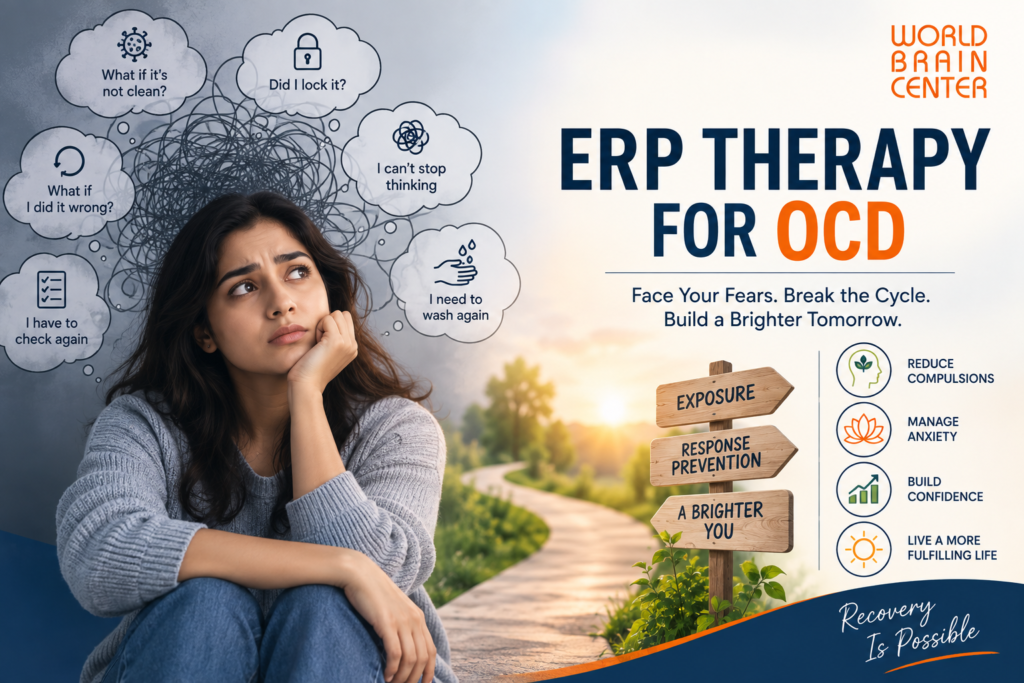
Living with Obsessive Compulsive Disorder (OCD) can be exhausting. An unwanted thought may appear repeatedly, creating anxiety or fear. The person may then feel compelled to check, wash, count, arrange, repeat, seek reassurance, or perform another ritual to feel safe.
The difficult part is that the compulsion may provide relief—but usually only temporarily. The same intrusive thought can return, followed by anxiety and another compulsion. Over time, this can create a repetitive cycle that becomes increasingly difficult to break.
This is where Exposure and Response Prevention (ERP) can play an important role.
ERP is a structured form of Cognitive Behavioural Therapy (CBT) specifically used in the treatment of OCD. It helps individuals gradually face situations, thoughts, images, objects, or uncertainties that trigger their OCD while learning to resist the compulsive response.
The goal is not to make a person completely free from anxiety. Instead, ERP helps them learn that anxiety and uncertainty can be experienced without automatically responding through compulsions or avoidance.
At World Brain Center Hospital, OCD treatment can involve psychological therapy, psychiatric evaluation, medication when clinically appropriate, and ongoing support based on the individual’s symptoms and treatment needs.
What Is Exposure and Response Prevention (ERP)?
Exposure and Response Prevention, commonly called ERP, is a CBT-based behavioural treatment for OCD.
The two parts of ERP are important:
Exposure
Exposure involves gradually and intentionally approaching an OCD trigger.
The trigger may be:
- A feared situation
- An object
- A thought
- An image
- A place
- A sensation
- Uncertainty about a possible outcome
Response Prevention
Response prevention means learning not to perform the compulsion or avoidance behaviour that usually follows the trigger.
For example, a person with contamination-related OCD may experience intense anxiety after touching a surface they consider dirty. Their usual response may be repeatedly washing their hands.
In therapist-guided ERP, the individual may gradually approach an appropriate contamination-related trigger and practise resisting excessive washing.
The exercise is planned according to the person’s symptoms, treatment goals, and ability to tolerate distress.
How Does ERP Work for OCD?
OCD often operates through a cycle:
Obsessive thought → Anxiety or distress → Compulsion → Temporary relief → Obsession returns
The temporary relief provided by a compulsion can reinforce the cycle.
ERP aims to interrupt this pattern.
Instead of teaching the person to eliminate every unwanted thought, ERP helps them respond differently when the thought appears.
Over repeated practice, the person can learn:
- Thoughts do not always require action.
- Anxiety can rise and fall without a ritual.
- Uncertainty can be tolerated.
- Avoidance is not the only way to feel safe.
- Compulsions are not necessary for managing every feared possibility.
This makes ERP therapy for OCD fundamentally different from simply telling someone to “stop thinking about it.”
Why Is Response Prevention So Important?
Exposure alone is not the complete treatment.
If a person faces an OCD trigger and immediately performs the usual compulsion, the underlying cycle may remain intact.
Response prevention gives the person an opportunity to practise a different response.
For example:
Trigger: “What if I made a mistake?”
Usual response: Repeatedly checking.
ERP response: Notice the uncertainty and resist unnecessary checking.
The aim is not to provide absolute certainty. Instead, the individual gradually learns to tolerate uncertainty without relying on compulsive behaviour.
Common ERP Techniques for OCD
ERP is highly individualized. A therapist does not use the same exposure exercise for every person with OCD.
1. In-Vivo Exposure
In-vivo exposure involves facing a feared situation or object in real life.
Depending on the individual’s OCD pattern, this might involve:
- Touching a surface associated with contamination fears
- Leaving an object slightly out of its preferred position
- Completing an everyday task without repeatedly checking
- Entering a situation that has been avoided
- Reducing excessive reassurance-seeking
The exposure should be carefully planned rather than forced.
2. Imaginal Exposure
Some OCD fears cannot easily be recreated in real life.
In such situations, a therapist may use imaginal exposure.
The individual may be guided to imagine or write about a feared situation while learning to tolerate the associated uncertainty and distress without performing mental rituals.
This approach can be particularly relevant when OCD involves feared consequences, intrusive images, or situations that cannot practically be recreated.
3. Response Prevention
Response prevention focuses specifically on reducing compulsive behaviours.
Compulsions may include:
- Excessive handwashing
- Repeated cleaning
- Checking locks or appliances
- Repeated reassurance-seeking
- Counting
- Repeating words or actions
- Arranging objects
- Mental reviewing
- Rumination
- Mental rituals intended to neutralize distress
The therapist helps the individual identify these patterns and gradually practise responding differently.
4. Graded Exposure
ERP is generally introduced gradually.
Rather than immediately confronting the most distressing fear, the therapist and patient may develop an exposure hierarchy.
The hierarchy can include situations ranging from relatively manageable to more challenging.
For example:
Lower distress → Moderate distress → Higher distress
This gradual approach allows the individual to develop confidence and treatment skills progressively.
Steps Involved in ERP Therapy for OCD
A structured ERP program commonly involves several stages.
Step 1: Assessment
The therapist first understands the individual’s:
- Obsessions
- Intrusive thoughts
- Compulsions
- Avoidance behaviours
- Triggers
- Emotional responses
- Impact on work and relationships
- Impact on everyday functioning
- Other psychological concerns
This assessment helps determine whether ERP is appropriate and how it should be structured.
Step 2: Treatment Planning
The therapist develops an individualized treatment plan based on the person’s OCD symptoms and treatment goals.
The objective is not simply to reduce anxiety temporarily. The broader goal is to improve functioning and reduce dependence on compulsions and avoidance.
Step 3: Creating an Exposure Hierarchy
Potential exposure situations are identified and organized according to factors such as distress level, relevance to the OCD cycle, and treatment priorities.
The person can then begin with manageable exercises before progressing toward more challenging situations.
Step 4: Practising Exposure
The individual intentionally approaches the selected trigger.
The therapist provides guidance and helps the person remain focused on the treatment objective rather than immediately escaping the situation.
Step 5: Preventing the Compulsion
This is the central component of ERP.
After encountering the trigger, the individual practises resisting the ritual or avoidance behaviour that would normally follow.
Over time, this can help weaken the connection between obsessive fears and compulsive responses.
Step 6: Reviewing Progress
After an exposure exercise, the therapist and patient discuss:
- What happened?
- What thoughts appeared?
- How did anxiety change?
- Was the compulsion resisted?
- What did the person learn?
- What should be adjusted for the next exercise?
Treatment is modified according to progress and individual needs.
Does ERP Make Anxiety Disappear?
Not necessarily—and this is an important part of understanding ERP.
The purpose of ERP is not to guarantee that a person will never experience anxiety again.
Instead, it helps individuals develop the ability to experience anxiety, uncertainty, or intrusive thoughts without automatically responding through compulsions.
With repeated practice, some people find that their anxiety becomes more manageable and that OCD has less control over their daily decisions.
The emphasis is therefore on building psychological flexibility and reducing the power of the OCD cycle, rather than demanding complete absence of uncomfortable thoughts.
ERP and OCD Behaviour Modification
OCD behaviour modification through ERP is not about forcing someone to stop compulsions.
A trained therapist works collaboratively with the individual to understand:
- What triggers the obsession
- What fear lies behind it
- What compulsion follows
- What relief the compulsion provides
- How avoidance maintains the cycle
The treatment then focuses on developing healthier behavioural responses.
This is particularly important because OCD can look very different from one individual to another.
Can ERP Be Combined With Medication?
Yes. Depending on the individual’s symptoms and clinical needs, ERP may be used alongside psychiatric medication.
SSRIs are among the medications commonly used in OCD treatment. A psychiatrist determines whether medication is appropriate based on factors such as symptom severity, co-existing conditions, previous treatment, and individual response.
Medication should only be started, changed, or stopped under the guidance of a qualified medical professional.
For some individuals, combining psychological therapy with psychiatric care provides a more comprehensive approach to OCD management.
How Effective Is ERP for OCD?
ERP is an established psychological treatment for OCD, and research supports its effectiveness for many individuals.
However, treatment outcomes differ from person to person.
Progress can be influenced by:
- Severity and type of OCD
- Duration of symptoms
- Co-existing mental health conditions
- Consistency with treatment exercises
- Individual response to therapy
- Access to appropriate professional support
Some individuals experience substantial symptom improvement, while others may require longer or more intensive treatment.
It is therefore better to view ERP as a structured recovery process rather than a guaranteed quick fix.
Benefits of ERP Therapy
With appropriate professional guidance, ERP may help individuals:
- Reduce compulsive behaviours
- Reduce avoidance
- Manage intrusive thoughts more effectively
- Improve tolerance of uncertainty
- Develop healthier coping strategies
- Regain confidence
- Spend less time performing rituals
- Improve work and academic functioning
- Improve relationships
- Participate more freely in everyday activities
The ultimate goal is to help the person spend less of life responding to OCD and more of life doing what genuinely matters to them.
Can ERP Be Practised at Home?
Some ERP exercises can be practised between therapy sessions.
A therapist may provide structured homework based on the treatment plan. Regular practice can help individuals apply skills in everyday situations.
However, it is not advisable to create highly distressing exposures independently, particularly when OCD symptoms are severe, complicated, or associated with significant emotional distress.
Professional guidance helps ensure that exposures are appropriate, gradual, and connected to the individual’s actual OCD cycle.
When Should You Seek Professional OCD Treatment?
Consider speaking with a qualified mental health professional if OCD symptoms:
- Consume significant amounts of your time
- Interfere with work or studies
- Affect relationships
- Prevent you from leaving home or participating in activities
- Cause repeated checking or cleaning
- Lead to constant reassurance-seeking
- Cause significant distress
- Make you avoid important parts of everyday life
You do not have to wait until OCD becomes overwhelming before seeking help.
Early assessment can help identify the problem and determine an appropriate treatment plan.
ERP Therapy and OCD Treatment at World Brain Center Hospital
At World Brain Center Hospital, OCD care can involve a coordinated approach between psychologists, psychiatrists, and other mental health professionals according to the individual’s needs.
Treatment may include:
- Psychological assessment
- ERP therapy
- Cognitive Behavioural Therapy
- Psychiatric evaluation
- Medication management when clinically indicated
- Behavioural interventions
- Family guidance
- Relapse-prevention planning
- Ongoing progress monitoring
Our approach focuses on understanding the individual—not simply treating a list of symptoms.
If OCD is affecting your daily life, professional support can help you understand the condition and explore evidence-based treatment options.
You Don’t Have to Let OCD Control Your Life
OCD can make ordinary situations feel threatening and simple decisions feel exhausting. But having intrusive thoughts does not mean you have to act on them.
ERP teaches a different way of responding.
Instead of constantly avoiding uncertainty, checking for reassurance, or performing rituals to reduce anxiety, individuals can gradually learn to face discomfort and continue with their lives.
Recovery is a process. It may take patience, regular practice, and professional guidance—but meaningful improvement is possible.
If you or someone you care about is struggling with OCD, speak with a qualified mental health professional at World Brain Center Hospital.
Contact World Brain Center Hospital
📞 011-41643347
📞 9968788861 | 9968788865 | 9968788867
Frequently Asked Questions About ERP Therapy for OCD
1. What is ERP therapy for OCD?
ERP, or Exposure and Response Prevention, is a CBT-based treatment in which individuals gradually face OCD triggers while learning to resist the compulsive behaviours that normally follow. It aims to weaken the cycle between obsessions, anxiety, and compulsions.
2. Is ERP effective for severe OCD?
ERP can be used for people with different levels of OCD severity. Individuals with more severe symptoms may require a more structured or intensive treatment plan, sometimes combined with psychiatric medication. A qualified professional should determine the appropriate approach.
3. Can ERP therapy be done at home?
Some therapist-planned ERP exercises can be practised at home between sessions. However, developing highly distressing exposures without professional guidance may not be appropriate. A trained therapist can help create a safe and individualized treatment plan.
4. How long does ERP therapy take?
There is no single duration that applies to everyone. Treatment length depends on factors such as OCD severity, symptoms, treatment response, co-existing conditions, and consistency with therapy exercises. A psychologist can recommend a treatment schedule after assessment.
Disclaimer
This article is intended for educational and awareness purposes only and does not replace professional medical or psychological consultation, diagnosis, or treatment. ERP exercises should be planned according to an individual’s clinical needs and should not be undertaken solely on the basis of information in this article. If you or a loved one is experiencing OCD symptoms, consult a qualified psychiatrist or psychologist for an appropriate assessment and personalized treatment plan.